
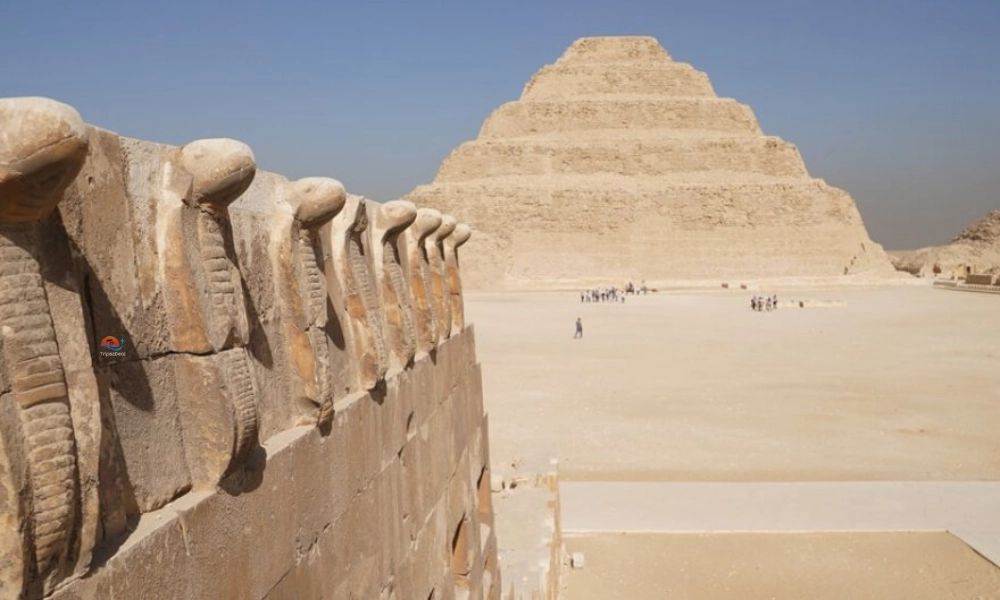
The pyramid is situated on the Saqqara plateau. The wind moves sand. You can see stone stairs in front of you. Djoser's Step Pyramid. That's where the narrative of the tall building begins. The steps go up the building like a ladder. Each step makes a big idea more real. Imhotep made the plans, and crews put the blocks together. In the sun, limestone shines. Even when it's quiet, desert walls talk. There has been a change in the design here.
This is the first large stone monument on Earth. Earlier tombs were mudbrick mastabas. Imhotep stacked mastabas into steps. That single idea changed architecture. It turned Egypt toward stone. It led to the smooth and sided giants at Dahshur and Giza. When you look at the steps, you see a prototype. You see a design in motion. You see the first draft of a world icon.
Djoser wanted a tomb that spoke of power and eternity. Imhotep answered with engineering genius. He organized quarries. He set standards for stone size and placement. He planned not just a tomb, but a sacred city around it. Later, Egyptians revered him. It called him a sage, a healer, and a master builder. His name travelled through time. You will remember your name after seeing his work.
The team quarried local limestone. They cut blocks to regular sizes. They laid them in tight horizontal courses. At first, the structure was small. Then the plan expanded. More layers. More height. The final climb involved six steps. The outer casing once shone in fine, light limestone. Sunlight would have made it glow. Today much of the casing is gone. The core remains. It still looks strong. It still looks ambitious.
Do not rush to the steps. Walk the complex. A tall enclosure wall once sealed this royal zone. Inside, you discover ritual courts. You see “dummy” chapels for the king’s Heb-Sed festival. These were not for daily worship. They were for the ceremony. They were to renew royal power for the afterlife.
Look for the joint entrance corridor. It feels like a stone forest. Tall, ribbed columns flank a narrow passage. They imitate wood but surpass it. Stone allows scale. Stone promises endurance.
Visit the Heb-Sed Court. Imagine Djoser running the ritual race to prove his vigour. See the markers. Picture priests, banners, music, and incense. The festival was a performance of rules. Here it never ends. The architecture keeps it going.
Find the serdab. This is a sealed room with a statue of Djoser. Two small eyeholes face the court. Through them, the king could “see” offerings. He could watch the eternal rites. He could stay present, even in death.
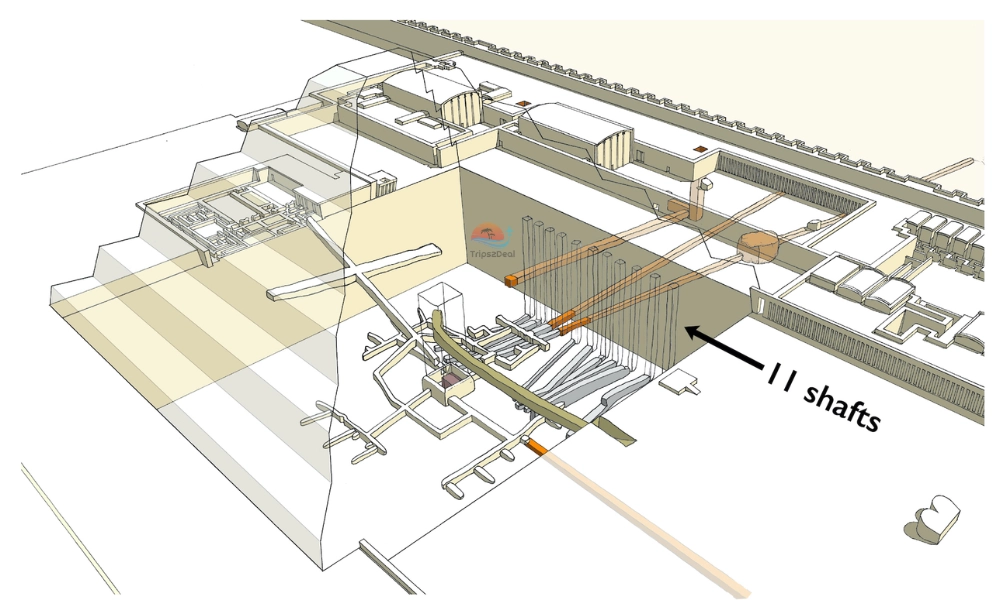
There are deep tunnels under the pyramid. There is a central shaft that leads to the burial chamber. Side passages branch like roots. Blue faience tiles line some corridors. They mimic reed mats. The palaces built for the living inspired the design of those constructed for the dead. The message is simple. The king will live well forever.
The steps are not smooth. They do not try to fake perfection. They show growth. They show a change in the plan. You can almost hear the builders deciding. Add another layer. Raise the silhouette. Make the statement bigger. The pyramid you see at Saqqara is a bold first attempt. It is honest. It is powerful because of that honesty.
Without Saqqara, there is no Bent, Red, or Great Pyramid. The step form taught lessons. It taught us how to manage weight effectively. The step form taught us how to plan ramps and teams effectively. They also learned how to quarry and move stone at scale. Later kings refined the geometry. They chased a perfect triangle. But the seed was here. If the Giza pyramids are symphonies, Saqqara is the first score. It sets the theme. It sets the rhythm.
Go early. The plateau is quiet and lit softly. It gives context. Then enter the complex. Take your time in the colonnade. Walk the courts. Circle the pyramid to feel its mass from every angle. If access is open, step inside with a guide. Respect signs and guards. UNESCO has named this a World Heritage Site. Be careful with it.
Come to Saqqara with open eyes. The desert holds the first chapter of pyramid building. The steps are simple, but the idea is grand. You see ambition carved into stone. You see a king who wanted time to remember him. You know an architect who made that wish real. Stand there. Breathe in the dry air. And let the world’s first pyramid speak to you clearly, directly, and forever.
© 2025 trips2deal. All rights reserved