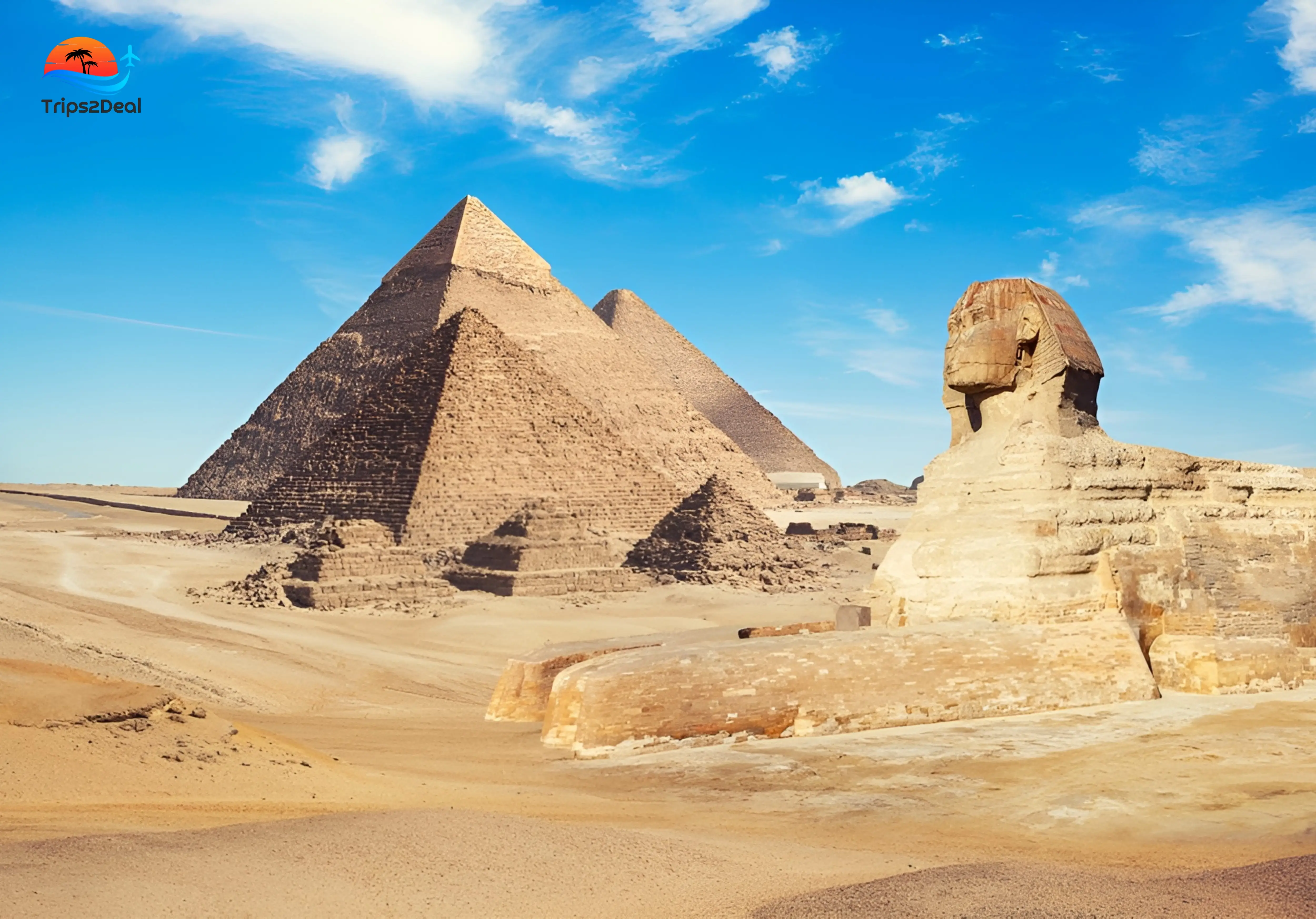

Did you hear the famous tales of Egypt from childhood? Civilization, faith, power, art, and legacy highlight the attractiveness of a city. After the Pyramids of Giza, you are surprised, who’s on the list? Discover the second most remarkable and iconic symbol of modern time, the Pyramid of Khafre which was built by Pharaoh Khafre (Chephren). This depicts itself as the timepiece on the Giza Plateau, becoming the most crucial part of the structure of ancient Egypt. Khafre’s is the landmark example of the royal ideology, funerary ritual, and meticulous development tools and tips. Whether you are a history-seeker or traveler, these monumental art and design will deliver a culture-centered afterlife continuity to all modern visitors.
In summary, the Pyramid of Khafre continues to be a visceral, must-see attraction for tourists visiting the Giza Plateau as well as a major scholarly resource for Egyptology. stays timeless.
The Pyramid of Khafre, which dates to Egypt's Fourth Dynasty, is credited to Pharaoh Khafre (Chephren), who probably came to power shortly after Khufu. Built around 2570 BCE, the pyramid is part of a larger funerary complex that also includes a mortuary temple, a long causeway, and a valley temple.
These elements combined ritual, architecture, and landscape design to uphold the king's cult and connect earthly rites to concepts of cosmic renewal. Examples of archeological remnants that reveal intricate cultic activity and the importance of the royal mortuary economy are statue fragments and temple foundations.
Highlights:
These features illustrate Old Kingdom state capacity in mobilizing labor, quarrying resources, and embedding cosmological symbolism in monumental architecture. This shows continuity.
On the Giza Plateau, Khafre's pyramid and the Great Sphinx combine to create a unified ritual ensemble. Widely interpreted as a royal portrait and guardian of the necropolis, the Sphinx, which was carved from bedrock close to the complex, combines a lion's body with a human head.
The interesting and surprising fact that makes tourists more curious to know about the Pyramids of the Sphinx. A continually flowing Nile has a strong connection with the holy necropolis due to a processional route. What exactly the necropolis is? an interrelation of causeway, mortuary temple, and valley temple. The Pharaoh has a strong connection to solar and divine cycles and was dominated by the power of choreography.
The ceremonial choreography is frequently felt by visitors. Without a doubt.
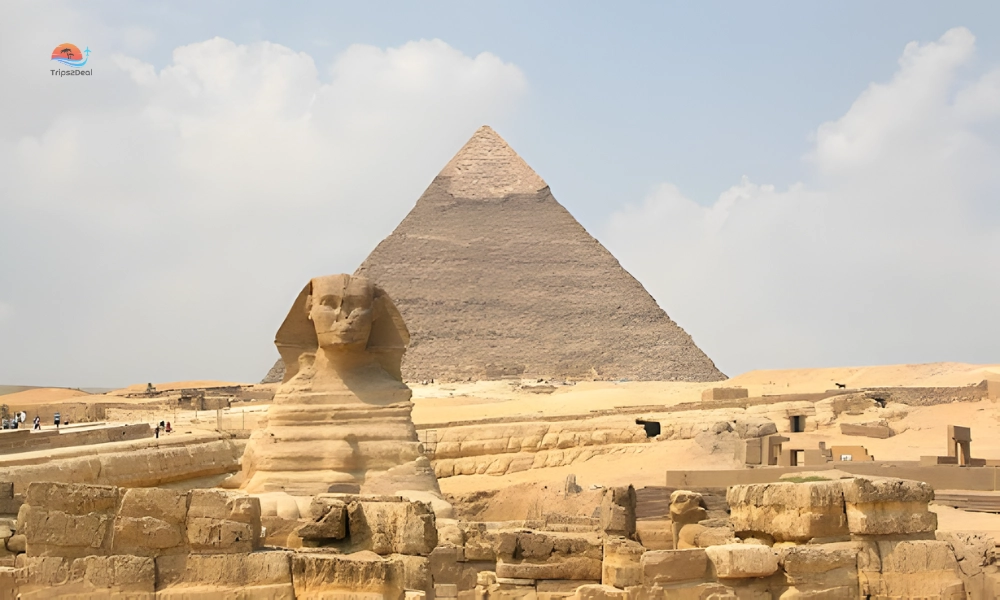
Looking for a royal tomb? Explore the Pyramid of Khafre; it is not only more than a gem, but a legacy that holds the history of several centuries. This spot is an iconic landmark that has a deep interrelation with a scholarly ideology of recent Egyptian history.
In order to build a strong connection, this design and architecture represent the sun’s rays, highlighting a bond between the pharaoh and Ra. This geometrical calculation analyzes the rebirth that demonstrates Khafre’s spirit to soar to the heavens. The complex structure of the Pyramid, causeways, and Sphinx deliver strong ritual practices, representing the ideas of divine kinship and eternal afterlife.
These religious connotations were not just theoretical; they were strongly linked to Egyptian conceptions of order and the afterlife (Maat).
A visit to the pyramid still prompts contemplation about the ways in which spiritual symbolism influenced enormous construction. It served as a link between earthly kingship and eternal divine existence, not merely a tomb.
If you compare the old monumental legacy with new and modern constructive details and balance the historical icons, the Pyramid of Khafre wins the race of architecture. Imagine, once it was too tall at 143.5 meters, but gradually, due to casing loss, it has reduced to 136 meters all. But when talking about the base, it is 215 meters wide. For the core, the workforce used large blocks of limestone. But for the exterior, architects prefer to use finer casing stones for an embellished look.
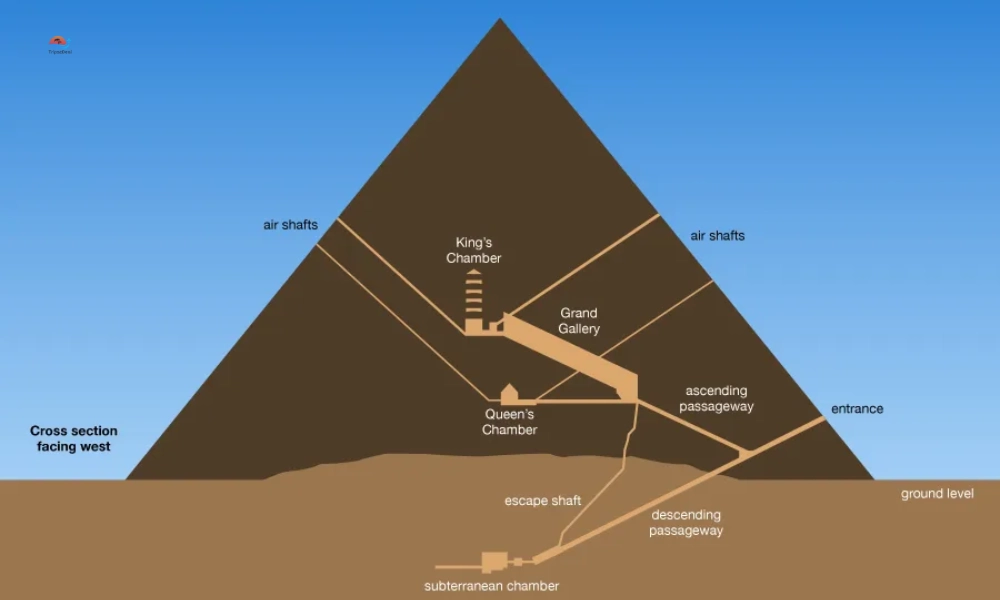
A patch of polished limestone near the summit is one of the most prominent relics and one of the best-preserved visual reminders of the pyramids' former grandeur. The interior of the structure has sloping hallways, rooms, and strategically positioned rest areas designed to protect the burial chamber.
This ensemble of features showcases both practical engineering solutions, like load distribution and stone transport, and ritual symbolism embedded in the built form. This blend underscores legacy.
Scholarly discussion and archaeological research are still centered on the Pyramid of Khafre. There are still unanswered questions about the logistics of construction, the role of rituals, and the connections between the monuments on the plateau.
By analyzing neighboring communities and quarry locations, researchers investigate workforce models and investigate whether the pyramids were constructed by organized professional crews or by large-scale corvee labor. Though some academics warn against over-interpretation without strong context, astronomical interpretations suggest alignments with stars or solar events that might reflect cosmological goals.
New methods are still being developed to improve dates and interpretations. More context and solutions are anticipated soon, thanks to ongoing interdisciplinary work.
The Giza Plateau as a whole and Khafre's pyramid are under constant, multidisciplinary protection. Natural weathering, groundwater rise, salt crystallization, air pollution, and heavy tourist traffic are among the threats.
As per the scientific facts, conservation strategies and planning prefer to follow up on small, reversible, and beneficial steps. Key initiatives include
These all strategies use contemporary technology like 3D scanning and non-destructive testing.
Heritage education and public outreach initiatives support local communities' stewardship. Commitment to long-term funding and policy is crucial.

For archaeological and scholarly debate, this place, the Pyramid of Khafre, is always a hot topic. There is a mysterious relationship always found between the monuments on the plateau, the functions of rituals, and the logistics of development.
Researchers examine workforce models and determine whether organized professional crews or large-scale corvée labor built the pyramids by examining nearby communities and quarry locations. Astronomical opinions and predications get aligned with the stars or solar events that may highlight the cosmological goals. But some scholars express their opinion that research goes against the over-interpretation. Moreover, this place is gradually becoming a tourist attraction that attracts millions of people to showcase its unique architecture and structure.
Book your guides and tips in advance. Must have a visit to other spots like the Great Pyramid, the Solar Boat Museum, and the Sound and Light Show for a clear image.
Do you want to explore ancient Egyptian engineering, ritual planning, and statecraft? Meet a Pyramid of Khafr, an outstanding legacy of the old civilization of Egypt. As per the connection with the Great Sphinx, this old kingdom is a rotatory story of architecture, religion, and monumental representation. For archaeologists and mysterious scientists, the Pyramid of Giza still holds the value as a crucial source of information.
© 2025 trips2deal. All rights reserved